Impact of discontinuing routine corticosteroid premedication on contrast reaction rates in high-risk patients: A clinical audit
DOI:
https://doi.org/10.46475/asean-jr.v27i3.1002Keywords:
Allergies, Contrast media, Contrast reactions, Corticosteroid premedication, High-risk patientsAbstract
Background: Recent guidelines question the efficacy of routine corticosteroid premedication for patients with asthma or multiple drug allergies undergoing contrast-enhanced computed tomography (CECT), citing limited evidence of its effectiveness.
Objective: To evaluate the incidence of documented contrast reactions following the cessation of routine corticosteroid premedication in high-risk patients.
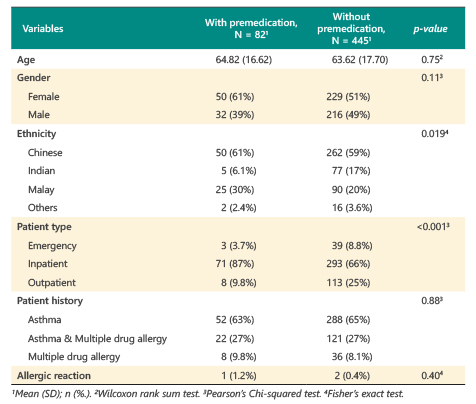
Materials and Methods: A retrospective single-centre audit was conducted from September 2021 to April 2022, including 527 patients undergoing CECT. Routine corticosteroid premedication was discontinued for high-risk patients (those with known asthma or multiple drug allergies, defined as allergies to three or more drug classes), except for individuals with confirmed contrast media allergies. Demographic and clinical data, including reaction severity, were collected using REDCap. Reaction rates between premedicated and non-premedicated groups were compared using appropriate statistical tests for categorical and continuous variables.
Results: Of 527 patients, 82 received premedication and 445 did not. Reaction rates were 1.2% (1/82) in the premedicated group and 0.4% (2/445) in the non-premedicated group (p = 0.4). All observed reactions were mild (grade 1–2), consisting mainly of urticaria, with no severe reactions recorded in either group. Demographics were comparable between groups.
Conclusion: Discontinuing routine corticosteroid premedication for high-risk patients was not associated with a statistically significant increase in contrast reactions in this audit and aligns with current guideline recommendations from professional bodies. However, due to the small number of events and the retrospective design, these findings should be interpreted with caution. Further studies are needed to confirm the safety of this approach in broader patient populations.
Downloads
References
Schöckel L, Jost G, Seidensticker P, Lengsfeld P, Palkowitsch P, Pietsch H. Developments in X-Ray contrast media and the potential impact on computed tomography. Invest Radiol 2020;55:592-7. doi: 10.1097/RLI.0000000000000696.
Parillo M, Quattrocchi CC, Pilato F, Di Lazzaro V, Beomonte Zobel B. Whole-body computed tomography as first-line imaging procedure to exclude cancer in patients with neurological suspicion of paraneoplastic syndromes: Shall clinical practice adhere to recommendations? Radiography 2023;29:8–13. doi: 10.1016/j.radi.2022.09.001.
Pruneti C, Guidotti S. Physiological stress as risk factor for hypersensitivity to contrast media: A narrative review of the literature and a proposal of psychophysiological tools for its detection. Physiologia 2022;2:55–65. doi: 10.3390/physiologia2030006.
American College of Radiology. ACR Manual on Contrast Media 2024 [Internet]. Reston (VA): ACR Committee on Drugs and Contrast Media; 2024 [cited 2026 Jul 9]. Available from: https://geiselmed.dartmouth.edu/radiology/wp-content/uploads/sites/47/2024/08/ACR-contrast-2024.pdf.
Currie GM. Pharmacology, Part 5: CT and MRI contrast media. J Nucl Med Technol 2019;47:189. doi: 10.2967/jnmt.118.220012.
Namasivayam S, Kalra MK, Torres WE, Small WC. Adverse reactions to intravenous iodinated contrast media: A primer for radiologists. Emerg Radiol 2006;12:210–5. doi: 10.1007/s10140-006-0488-6.
Wu YW, Leow KS, Zhu Y, Tan CH. Prevention and management of adverse reactions induced by iodinated contrast media. Ann Acad Med Singap 2016;45:157–64.
Omer HM, Hodson J, Thomas SK, Coleman JJ. Multiple drug intolerance syndrome: A large-scale retrospective study. Drug Saf 2014;37:1037–45. doi: 10.1007/s40264-014-0236-x.
Mervak BM, Davenport MS, Ellis JH, Cohan RH. Rates of breakthrough reactions in inpatients at high risk receiving premedication before contrast-enhanced CT. AJR Am J Roentgenol 2015;205:77–84. doi: 10.2214/AJR.14.13810.
Davenport MS, Cohan RH, Caoili EM, Ellis JH. Hyperglycemic consequences of corticosteroid premedication in an outpatient population. AJR Am J Roentgenol 2010;194:W483–8. doi: 10.2214/AJR.09.3906.
European Society of Urogenital Radiology [Internet]. ESUR Guidelines on contrast agents 10.0 [cited 2026 Jul 9]. Available from: www.esur.org/wp-content/uploads/2022/03/ESUR-Guidelines-10_0-Final-Version.pdf
Katayama H, Yamaguchi K, Kozuka T, Takashima T, Seez P, Matsuura K. Adverse reactions to ionic and nonionic contrast media. A report from the Japanese Committee on the Safety of Contrast Media. Radiology 1990;175:621–8. doi: 10.1148/radiology.175.3.2343107.
Cheng DWL, Chiew JL, Wong PMP, Lee CH, H’ng MWC. Asthma, drug allergies and iodinated contrast media: A retrospective evaluation and proposed CT workflow. Ann Acad Med Singap 2021;50:441–3. doi: 10.47102/annals-acadmedsg.2020563.
Schrijvers R, Demoly P, Chiriac AM. Premedication for iodinated contrast media induced immediate hypersensitivity reactions. Current Treat Options Allergy 2019;6:538–53. doi: 10.1007/s40521-019-00224-z.
Rosado Ingelmo A, Doña Diaz I, Cabañas Moreno R, Moya Quesada MC, García-Avilés C, García Nuñez I, et al. Clinical practice guidelines for diagnosis and management of hypersensitivity reactions to contrast media. J Investig Allergol Clin Immunol 2016;26:144–55; quiz 2 p following 155. doi: 10.18176/jiaci.0058.
O’Malley RB, Cohan RH, Ellis JH, Caoili EM, Davenport MS, Dillman JR, et al. A survey on the use of premedication prior to iodinated and gadolinium-based contrast material administration. J Am Coll Radiol 2011 ;8:345–54. doi: 10.1016/j.jacr.2010.09.001.
Waljee AK, Rogers MA, Lin P, Singal AG, Stein JD, Marks RM, et al. Short term use of oral corticosteroids and related harms among adults in the United States: Population based cohort study. BMJ 2017;357:j1415. doi: 10.1136/bmj.j1415.
Davenport MS, Mervak BM, Ellis JH, Dillman JR, Dunnick NR, Cohan RH. Indirect cost and harm attributable to oral 13-hour inpatient corticosteroid Prophylaxis before Contrast-enhanced CT. Radiology 2016;279:492–501. doi: 10.1148/radiol.2015151143.
Downloads
Published
How to Cite
Issue
Section
License
Copyright (c) 2026 The ASEAN Journal of Radiology

This work is licensed under a Creative Commons Attribution-NonCommercial-NoDerivatives 4.0 International License.
Disclosure Forms and Copyright Agreements
All authors listed on the manuscript must complete both the electronic copyright agreement. (in the case of acceptance)